
Introduction
The technology landscape in 2026 is evolving faster than ever. AI-powered systems, cloud-native platforms, DevOps automation, cybersecurity demands, and scalable startup architectures are redefining how software is built and maintained.
Choosing the right programming language in 2026 is no longer just about syntax—it’s about career longevity, industry demand, and future-proof skills.
At NuageNetz, we work closely with enterprises, startups, and cloud-native teams. Based on real-world projects, hiring trends, and global tech adoption, here’s our expert-curated list of the best programming languages to learn in 2026.
Why Choosing the Right Programming Language Matters in 2026
In 2026, technology decisions move faster—and mistakes cost more. With AI-driven systems, cloud-native platforms, DevOps automation, and enterprise-scale digital transformation becoming the norm, choosing the right programming language is no longer just a technical choice—it’s a strategic one.
The programming language you choose directly impacts performance, scalability, security, hiring potential, and long-term business success.
🤖 AI Growth Demands Intelligent & Flexible Languages
☁️ Cloud-Native Applications Need Scalability by Design
Modern applications are built for the cloud from day one. Microservices, serverless functions, APIs, and containerized workloads all demand languages that are lightweight, scalable, and cloud-friendly.
Choosing a language that aligns with cloud-native principles ensures:
-
Faster deployment
-
Better resource efficiency
-
Easier maintenance at scale
AI and machine learning are now embedded into everyday applications—from chatbots and recommendation engines to autonomous workflows.
In 2026, the right language must support AI frameworks, data processing, and rapid experimentation while remaining production-ready.
Languages with strong AI ecosystems enable faster innovation, easier model integration, and smoother collaboration between developers and data teams.
⚙️ DevOps & Automation Rely on Language Ecosystems
DevOps in 2026 thrives on automation—CI/CD pipelines, infrastructure as code, monitoring, and testing are deeply integrated into development workflows.
The right programming language simplifies automation and integrates seamlessly with DevOps tools, cloud platforms, and orchestration systems.
🔐 Cybersecurity Starts with Language Selection
Security threats are increasing, and organizations can’t afford vulnerabilities caused by weak language support or outdated practices.
In 2026, the right language helps enforce secure coding standards, memory safety, dependency management, and compliance.
Languages designed with security in mind reduce attack surfaces and help developers build safer applications from the ground up.
Top Programming Languages to Learn in 2026
In 2026, the most valuable programming languages are those that power AI innovation, cloud-native systems, DevOps automation, secure applications, and enterprise-scale platforms. Rather than focusing on a single domain, today’s top languages are multi-purpose, highly adopted, and future-ready. They help developers build intelligent systems, scalable cloud applications, and reliable enterprise software—making them essential for long-term career growth.
Python: The Most In-Demand Programming Language in 2026
Python continues to dominate in 2026 because of its unmatched versatility and ecosystem strength. It sits at the center of AI, automation, cloud computing, and DevOps.
Why Python Leads in 2026
AI & Machine Learning: Python is the backbone of modern AI development. Most AI frameworks, data pipelines, and intelligent systems are built around Python, making it the first choice for AI engineers.
Automation & DevOps: Python is widely used for scripting, infrastructure automation, configuration management, and monitoring—reducing manual work and speeding up deployments.
Cloud Computing: Python integrates seamlessly with AWS, Azure, and Google Cloud, enabling serverless functions, cloud APIs, and backend services.
Ease of Learning: Its simple syntax allows beginners to start quickly while still supporting advanced system design.
Real-World Use Cases: AI-powered chatbots, recommendation engines, cloud automation tools, data analytics platforms, fintech applications, and SaaS products.
In 2026, Python is not just a language—it’s a foundation skill.
JavaScript & TypeScript: The Core of Modern Web and Full-Stack Development
JavaScript and TypeScript remain essential in 2026 because the web is still the primary platform for digital experiences.
Why They Matter in 2026
Web Development: JavaScript powers interactive, high-performance user interfaces across browsers and devices.
TypeScript for Scale: TypeScript adds strong typing and structure, making large codebases easier to manage and safer to scale.
Full-Stack Applications: Developers use JavaScript/TypeScript on both frontend and backend, enabling faster development and shared logic.
Cloud Platforms: These languages are widely used in serverless functions, APIs, and edge computing.
Scalable Systems: Ideal for startups and enterprises building high-traffic, real-time applications.
Cloud & DevOps in 2026
Cloud and DevOps workflows demand speed, reliability, and automation. These three languages dominate the space.
Their Role in 2026
Python: Used for cloud automation, infrastructure scripting, monitoring tools, and DevOps pipelines.
Go: Known for performance and concurrency, Go is heavily used in cloud-native tools, microservices, and Kubernetes ecosystems.
Bash: Still critical for scripting, system automation, and CI/CD pipelines at the OS and infrastructure level.
Key Use Areas
Kubernetes: Go powers many Kubernetes tools; Python and Bash help automate deployments and maintenance.
CI/CD Pipelines: All three are used to build fast, reliable deployment workflows.
Cloud Automation: From provisioning resources to scaling services automatically.
AI & Data Science Programming Languages in 2026
AI and data-driven decision-making are central to businesses in 2026, making Python and R highly valuable.
Why They Dominate
Python: Used for AI models, deep learning, data pipelines, and production-ready ML systems.
R: Preferred for advanced statistics, data visualization, and research-heavy analytics.
Real-World Industry Applications
Healthcare predictive analytics
Financial risk modeling
Marketing personalization
Smart manufacturing and IoT analytics
Government and policy data analysis
Why Java, C#, and Kotlin Still Matter in 2026
Despite newer languages, Java, C#, and Kotlin remain highly relevant for enterprise and mission-critical systems.
Their Continued Importance
Enterprise Software: Trusted for stability, performance, and long-term support.
Banking & Fintech: Used for secure, high-volume transaction systems.
Large-Scale Systems: Excellent for complex architectures that require reliability and maintainability.
Kotlin: Modern, concise, and widely used for Android and backend services.
These languages power core business systems where reliability matters more than trends.
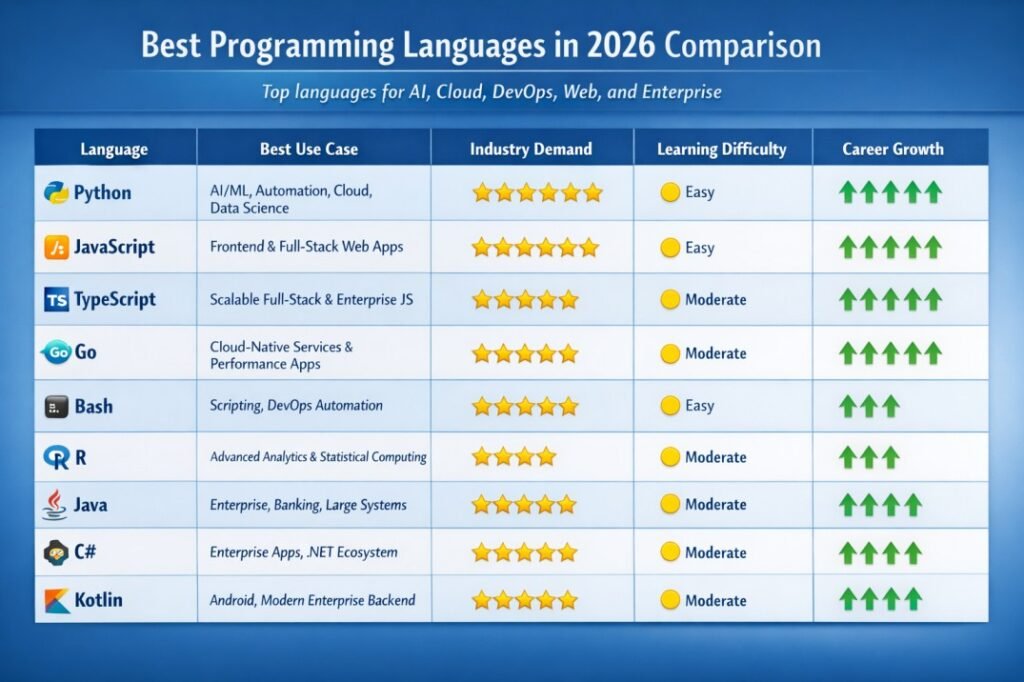
Comparison table best programming languages in 2026
Learning Strategy Recommended by NuageNetz
Start with one core language
Add cloud & DevOps skills
Practice on real-world projects
Understand system design basics
Learn AI & automation concepts
Final Thoughts: Build a Future-Proof Tech Career with NuageNetz
The best programming language in 2026 is the one that aligns with industry demand, emerging technologies, and your career vision.
At NuageNetz, we don’t just build software—we build future-ready professionals and scalable digital solutions.
🚀 Ready to Level Up Your Tech Career?
Learn industry-relevant skills
Work on real-world cloud & DevOps projects
Partner with experts shaping modern IT solutions
Conclusion: Future-Ready Skills Are the Key to Success in 2026
As we step into 2026, the software industry is evolving faster than ever. AI-driven applications, cloud-native platforms, DevOps automation, cybersecurity demands, and large-scale enterprise transformation are no longer future trends—they are today’s reality. In this environment, learning future-ready programming languages is not optional; it’s essential for staying relevant, competitive, and confident in your career.
The right programming languages empower you to build intelligent systems, scalable cloud solutions, secure applications, and high-impact products. Whether you are a student starting your journey, a developer aiming for senior roles, a DevOps engineer optimizing infrastructure, or an AI professional shaping the future—your skill choices in 2026 will define your growth for years to come.