
Why 2026 Is a Turning Point for AI & ML
Artificial Intelligence (AI) and Machine Learning (ML) are no longer buzzwords. In 2026, they have become the backbone of digital transformation across industries. From smart assistants and recommendation engines to autonomous systems and predictive analytics, AI is deeply embedded in our everyday lives.
For developers, IT professionals, startups, and business leaders, understanding the AI & Machine Learning evolution in 2026 is not optional—it is essential. The way software is built, deployed, and scaled has fundamentally changed due to intelligent systems that can learn, adapt, and make decisions with minimal human intervention.
This blog explores the complete journey of AI and ML, the key AI trends in 2026, real-world applications, challenges, and what the future holds beyond 2026
Evolution of AI & Machine Learning Till 2026
Early Days: Rule-Based AI (Before 2010)
AI began with rule-based systems, where machines followed predefined instructions. These systems were:
Predictable
Limited in scope
Unable to learn from data
Examples included basic chatbots, expert systems, and logic-based programs.
Data-Driven Machine Learning (2010–2020)
With the explosion of data and cloud computing, machine learning gained momentum:
Algorithms learned patterns from data
Systems improved over time
Supervised and unsupervised learning became common
This era gave rise to recommendation systems, spam filters, and image recognition.
Deep Learning & Big Models (2020–2024)
Deep learning transformed AI by using neural networks inspired by the human brain:
Natural Language Processing (NLP) improved dramatically
Computer vision reached near-human accuracy
Large language models changed content creation and coding
AI Maturity Phase (2025–2026)
By 2026, AI has entered a maturity phase:
Models are smaller, faster, and more efficient
AI systems can reason, plan, and self-correct
Integration with edge devices and IoT is seamless
The AI evolution in 2026 focuses on intelligence, autonomy, and responsibility.
Key AI & ML Trends in 2026
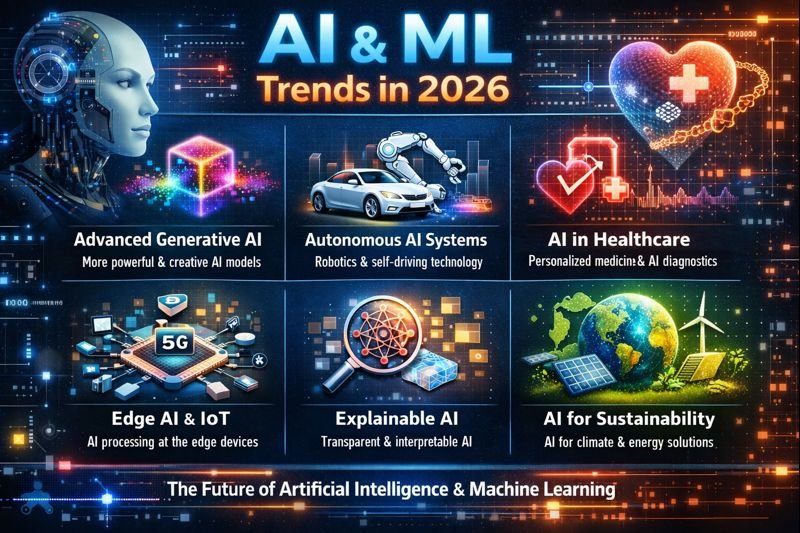
1. Generative AI Beyond Text
In 2026, Generative AI is no longer limited to text or images. Developers now build systems that generate:
Code
APIs
UI components
Test cases
Infrastructure configurations
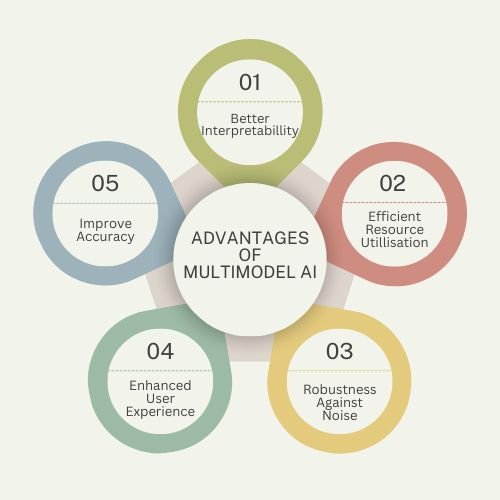
2. Multimodal AI as the New Normal
AI systems now understand text, images, audio, video, and sensor data simultaneously.
Example:
A smart healthcare app can:
- Read medical reports (text)
Analyze X-rays (images)
Interpret doctor’s voice notes (audio)
Track wearable data (sensors)
3. AutoML & Developer Productivity
AutoML tools now:
Select models automatically
Tune hyperparameters
Optimize performance
Deploy to cloud or edge
4. Edge AI and On-Device Intelligence
Instead of relying only on cloud servers:
AI models run directly on devices
Faster response times
Better privacy and security
Smartphones, wearables, and industrial sensors are powered by edge AI.
AI in the Software Development Lifecycle (SDLC)
1. AI-Powered Coding
- Intelligent code suggestions
- Automatic bug detection
- Code refactoring recommendations
- Security vulnerability scanning
2. AIOps & Smart DevOps
AI now manages:
Infrastructure scaling
Log analysis
Incident prediction
Root cause analysis
DevOps has evolved into AIOps, making systems more resilient and self-healing.
Role of AI for Developers in 2026
In 2026, the role of developers has evolved alongside the rapid growth of artificial intelligence. AI is no longer just a tool that developers build for others—it has become an intelligent partner in the development process itself. Modern developers work with AI, not separately from it. AI systems now assist in writing code, suggesting better logic, identifying bugs, improving performance, and even generating documentation. This collaboration helps developers save time and focus more on solving real-world problems rather than repetitive tasks.
AI has significantly changed how software is designed and delivered. Developers can now build complex applications faster by integrating pre-trained AI models instead of creating everything from scratch. Tasks like code refactoring, security scanning, test case generation, and deployment optimization are increasingly handled by AI-powered tools. This shift has reduced development cycles and improved overall code quality, making teams more productive and efficient.
For startups and businesses, AI-enabled developers bring a major competitive advantage. They can build scalable, intelligent products faster and adapt quickly to market changes. As the Machine Learning future continues to unfold, developers who embrace AI will lead innovation, while those who ignore it may struggle to keep pace.
In simple terms, AI for developers in 2026 is not about losing jobs—it is about gaining superpowers. Developers who learn to work alongside AI will shape the next generation of intelligent technology.
Challenges & Ethical Concerns in AI (2026)
As artificial intelligence becomes more powerful and deeply integrated into daily life, the challenges and ethical concerns surrounding its use have also grown in 2026. One of the biggest concerns is data privacy. AI systems depend heavily on large volumes of data, including personal and sensitive information. If this data is not handled properly, it can lead to misuse, data breaches, and loss of user trust. Businesses and developers are now under strong pressure to follow strict data protection laws and ensure transparency in how data is collected and used.
Another major challenge is bias and fairness in AI systems. AI models learn from historical data, and if that data contains bias, the AI may produce unfair or discriminatory outcomes. This can impact areas such as hiring, lending, healthcare, and law enforcement. In 2026, organizations are increasingly focusing on building unbiased datasets and testing AI systems regularly to ensure fair decision-making. Ethical AI is no longer optional—it is a responsibility.
Overall, the future of AI depends not just on innovation, but on responsible, ethical, and human-centered development.
The Future After 2026 (What to Expect)
AI assistants will work like teammates
Software will update itself
Human + AI collaboration will increase
Ethical AI rules will be stricter
Developers will become decision makers, not just coders.
Conclusion
The AI & Machine Learning evolution in 2026 clearly shows that intelligent technology has moved beyond experimentation and hype. AI is now practical, powerful, and deeply integrated into how software is built, businesses operate, and decisions are made. From autonomous systems and real-time analytics to AI-assisted development and industry-wide automation, intelligent systems are shaping a smarter digital future.
For developers, AI has become a trusted partner that improves productivity, creativity, and efficiency. For startups and businesses, AI offers faster growth, better customer experiences, and data-driven decision-making. At the same time, responsible AI practices—such as transparency, fairness, and data privacy—are more important than ever to ensure long-term trust and sustainability.
In simple words, AI is not just the future—it is the present, and its evolution in 2026 marks the foundation of a more intelligent, connected, and responsible technological world.